

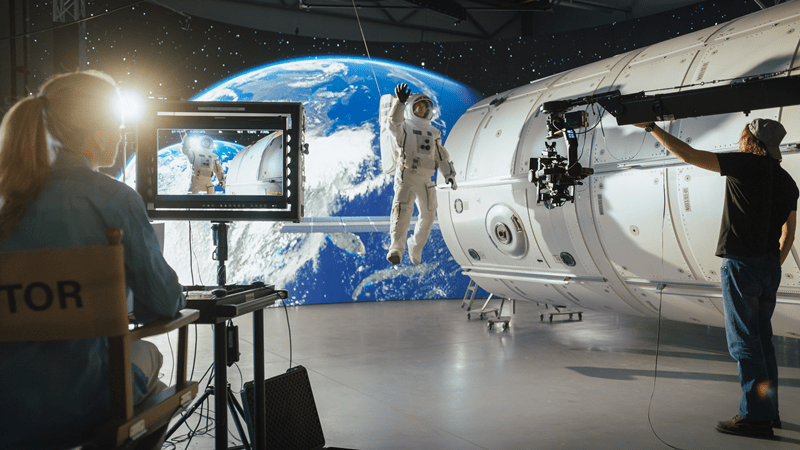
Ever since film noirs to spaceships blowing up, real-life dinosaurs and mind-bending fantasy universes, contemporary cinematography is strongly dependent on visual magic. Debate over CGI vs practical effects movies has long been a contention among film-makers, and still today audiences debate which method really appears better on screen. There are those who are captivated by the endless opportunities offered by digital images, and those who stand by the physical effects that are produced on-screen.
To be more precise, assuming that a U.S. viewer was brought up on Jurassic Park and the Marvel Cinematic Universe, it is best to consider the evolution of effects, their usage in modern cinema, and the reason why the most successful movies tend to combine the two. This movie VFX guide not only deconstructs CGI in films but also provides consequences that can be put into practice and comprehensive with the practical effects explained in easy to understand words and a visual effects comparison that can be traced to real-life movie examples.
In order to gain proper understanding of CGI vs practical effects movies, it is useful to refer to the history of film effects.
Since that time, the CGI vs practical effects movies debate has indeed started.
CGI in films is an image which is generated or supplemented by means of computer programs.
Nevertheless, CGI, when it is too much or too quickly created, tends to give viewers a feeling that something is not quite right. It is at this point where the outcry about CGI vs practical effects movies is the loudest.
To know the other half of the CGI vs practical effects movies, we must have the practical effects explained in a clear manner.
The Dark Knight, Mad Max: Fury Road, and Jaws are movies that are frequently commended due to the practical effects that producers have used to give them weight and realism, which people subconsciously believe. There is a common perception that in the CGI vs practical effects films debate, practical effects are the ones that age more with time.

The comparison of the visual effects is fair without stating that one approach is necessarily better than the others. Rather, it focuses on the best each has to offer.
CGI shines when:
When people disapprove of CGI in films, they are typically responding to visuals that have been poorly incorporated rather than the technology. Similarly, practical effects fail when they appear old-fashioned or stifle the creative spirit. This is the equilibrium of the CGI vs practical effects movies debate.
One of the key factors that make audiences change their mind about the use of CGI or practical effects in making a movie is execution.
This does not imply making CGI necessarily worse. Indeed, even the most impressive visual scenes in films are dependent on digital effects that the audience does not even bother to observe- evidence of the fact that even the most understated CGI can easily beat the visual effects race without drawing much attention to itself.
Although the practical effects clarified tend to sound better, it is limited. Destroying a large scale, fantasy monsters, or alien worlds can be either prohibitive in terms of cost or physically impractical to stack.
Therefore, in the CGI vs practical effects movies discussion, it must be noted that the practical effects are not necessarily the way to go.
The movies of today are unlikely to follow any particular side fully, as they are visually impressive. On the contrary, they hybridize the two approaches. This mixed approach is usually the actual winner of CGI vs practical effects movies.
This is the most reliable method as far as movie VFX guides are concerned. The mix may not be conscious to the audience, but it is experienced when the visuals are made grounded and spectacular.
Nostalgia is another aspect that was not considered in CGI vs practical effects movies.
Therefore, which one of these CGI vs practical effects movies looks better on screen? It is a sincere response of: either one, used wisely.
In practice, effects usually prevail in terms of realistic credibility. CGI triumphs over range, fantasy and narrative liberation. The most powerful movies know what they need and make their decisions.
The contemporary viewers do not seek fewer effects, but better effects. An informed, well-constructed combination made informed by a history of film effects, buttressed by intelligent use of CGI in movies, and based on the practical effects, explicated through a clear explanation of execution is likely to provide the most satisfying visual impression.
There is one fact that is clear at the conclusion of this VFX guide. The visual effects must be used in the story but not dominate over the story. Regardless of the film veering towards CGI or the use of practical effects, the eye of the audience must be respected and it takes planning, skills and a respect to the audience.
The argument of CGI versus practical effects movies will probably be on as long as technology exists. However, when the directors are more interested in telling stories and employ appropriate tools at the appropriate time, the movie is not only visually spectacular but is an experience to remember.
No, practical effects are not being completely eliminated by CGI. Though CGI in movies has been more sophisticated and extensively utilized, most of the contemporary works still use a combination of both. In the current CGI versus practical effects movie argument, film directors would rather mix the two since the practical effects bring grounding to the movie whereas CGI brings up size and fantasy. This is a hybrid that is the new industry standard.
A large number of viewers believe that the practical effects are more realistic as they are in the form of real objects on the set. In cases where practical effects are described in simple terms, they consist of actual props, makeup and stunts that will naturally interact with the actors and lighting. Practical effects tend to age better in a visual effects comparison, and in this regard, audiences sometimes disparage clichéd use or bad use of CGI.
No clear winner in CGI vs practical effects movies. The future of filmmaking is in equilibrium. Development of CGI in movies will keep on, yet realistic methods and acting will still be very necessary. The most successful movies apply the right effect to the right scene as per the history of film effects and this is a testament that choices based on story are more important than the actual technology.
This content was created by AI